Earthquake Active Zones in Southeast Sulawesi, Based on Hypocenter Relocation Using Double-Difference Method
DOI:
https://doi.org/10.56099/jrgi.v8i02.178Keywords:
Earthquake Active Zones, Hypocenter Relocation, Depth Earthquake, Southeast SulawesiAbstract
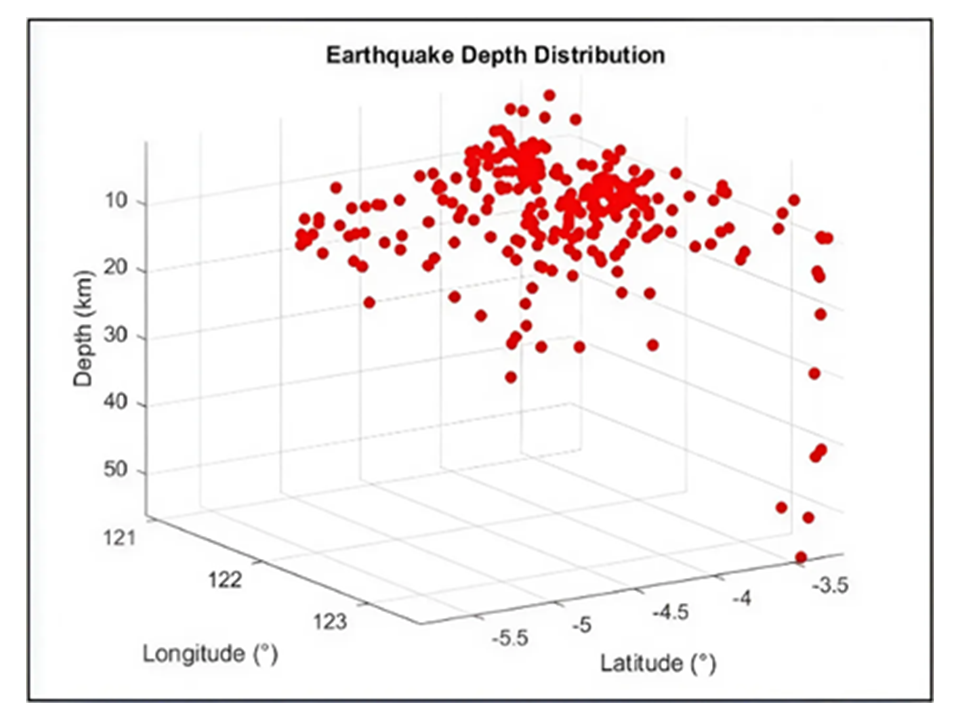
Earthquake active zones can be identified based on the distribution of their hypocenters. Sometimes, information on earthquake occurrences must be provided as soon as possible, so earthquake hypocenters are not precise. A catalog of earthquakes that have been relocated by including local earthquakes recorded by significant additions to the seismic sensor network is needed. Earthquake hypocenter relocation in Southeast Sulawesi was performed using the hypocenter double difference method on earthquake event data from January to December 2024, to determine the earthquake active zones. Earthquake event data at coordinates 02°45' - 06°15' South Latitude and 120°45' - 124°30' East Longitude. The hypocenter relocation process using the hypoDD program and the 1D ak-135 velocity model, produces a total of 277 relocated earthquake events using 21 recording sensor locations. The results of the earthquake hypocenter relocation are clearly visible in the clustered (close together) earthquake events. The depth of the earthquake after relocation is a shallow depth earthquake (h<60 km), with varying values of depth, not only through fixed depth of 10 km or other. In 2024 there there are six earthquake active zones, including Kolaka Regency, East Kolaka Regency, South Konawe Regency, southern Konawe Regency, Kendari City, Kabaena Island, and one zone in the eastern waters of Southeast Sulawesi (north of Wawonii Island, Konawe Islands Regency).
References
Ali, Y. H. and Suardi, I. (2018). Crustal thickness beneath Jailolo region constructed from P wave receiver function. AIP Conference Proceedings, 1987(1), 020038. https://doi.org/10.1063/1.5047323
Arifin, L. and Tomy, N. (2015). Struktur geologi di perairan Buton Selatan, Jurnal Geologi Kelautan, 13(3), 143-151.
Arimuko, A., Nanda, B. M., & Rasmid, R. (2020). Identifikasi Struktur Bawah Permukaan Berdasarkan Pemodelan Kecepatan 1D Hasil Relokasi Hiposentrum Gempa di Pulau Lombok, Gunung Sinabung, dan Jailolo. Jurnal Geofisika, 18(2), 40–48. https://doi.org/10.36435/jgf.v18i2.440
Bidang Informasi Gempabumi dan Peringatan Dini Tsunami. (2021). Katalog Gempabumi Indonesia: Relokasi Hiposenter dan Implikasi Tektonik. Pusat Gempabumi dan Tsunami Kedeputian Geofisika Badan Meteorologi, Klimatologi, dan Geofisika, Indonesia. ISBN: 978-623-98986-0-1.
Bormann, P., Engdahl, E. R. and Kind, R. (2012). New Manual of Seismological Observatory Practice (NMSOP-2), IASPEI. GFZ German Research Centre for Geosciences, Postdam; http://nmsop.gfz-postdam.de; doi: 10.2312/GFZ.NMSOP-2.
Chang, T.-W. and Ide, S. (2021). Hypocenter hotspots illuminated using a new cross-correlation based hypocenter and centroid relocation method. Journal of Geophysical Research: Solid Earth, 126, e2021JB021991. https://doi.org/10.1029/2021JB021991
Cipta, A., Robiana, R., Griffin, J. D., Horspool, N., Hidayati, S. and Cummins, P. (2016). A probabilistic seismic hazard assessment for Sulawesi, Indonesia. In P. R. Cummins, & I. Meilano (Eds.), Geohazards in Indonesia: Earth science for disaster risk reduction, 441, pp.133–152. The Geological Society of London. https://doi.org/10.1144/SP441.6
De Barros, L., Baques, M., Godano, M., Helmstetter, A., Deschamps, A., Larroque, C. and Courboulex, F. (2019). Fluid-Induced Swarms and Coseismic Stress Transfer: A Dual Process Highlighted in the Aftershock Sequence of the 7 April 2014 Earthquake (Ml 4.8, Ubaye, France). J Geophys Res Solid Earth, 124, 3918–3932. doi: 10.1029/2018JB017226
Engdahl, E. R., Villasenor, A., DeShon, H. R. and Thurber, C. H. (2007). Teleseismic Relocation and Assessmentof Seismicity (1918-2005) in The Region of the 2004 Mw 9.0 Sumatra-Andaman and 2005 Mw 8.6 Nias Island Great Earthquakes. Bull. Seismol Soc. Am, 97, S43-S61. doi: 10.1785/0120050614.
Frohlich, C. (2006). Deep earthquakes. Cambridge University Press. https://doi.org/10.1017/CBO9781107297562
Geiger, L. (1912). Probability Method for The Determination of Earthquake Epicenters from The Arrival Time Only. Bull. St. Louis Univ, 8(1), 56–71.
Gomberg, J. S., Shedlock, K. M. and Roecker, S. W. (1990). The effect of S-wave arrival times on the accuracy of hypocenter estimation, Bull. Seism. Soc. Am, 80, 1605–1628.
Got, J.-L., Fre´chet, J. and Kleim, F. W. (1994). Deep Fault Plane Geometry Inferred from Multiplet Relative Relocation Beneath the South Flank of Kilauea. J. Geophys Res, 99(15), 375 – 15,386.
Hatch, R. L., Abercrombie, R. E., Ruhl, C. J. and Smith, K. D. (2020). Evidence of Aseismic and Fluid‐Driven Processes in aSmall Complex Seismic Swarm Near Virginia City, Nevada. Geophys Res Lett, 47. doi: 10.1029/2019gl085477
Hayes, G. P., Wald, D. J. and Johnson, R. L. (2012). Slab 1.0: A Three-Dimensional Model of Global Subduction zones Geometries. J. Geophys Res, 117: B01302. doi:10.1029/2011JB008524.
Hijriani, A., Sahara, D. P., Nugraha, A. D., Ramadhan, I. and Sidik, R. P. (2017). Peningkatan Akurasi Lokasi Gempa Mikro Dengan Menggunakan Metoda Double-Difference Dan Korelasi Silang Master Waveform. Jurnal Geofisika, 15(3), 21–25. https://doi.org/10.36435/jgf.v15i1.33
Hutchings, S. J. and Mooney, W. D. (2021). The Seismicity of Indonesia and Tectonic Implications. Geochemistry, Geophysics, Geosystems, 22, e2021GC009812. https://doi.org/10.1029/2021GC009812
Jatnika, J., Nugraha, A. D. and Wandono, W. (2015). Relokasi Sumber Gempa Di Daerah Sumatera Bagian Utara Menggunakan Hasil Inversi Simultan Relokasi dan Kecepatan Gelombang P Tiga Dimensi. Jurnal Meteorologi dan Geofisika, 16(2). https://doi.org/10.31172/jmg.v16i2.274
Kato, A. (2024). Implications of Fault‐Valve Behavior from Immediate Aftershocks Following the 2023 Mj6.5 Earthquake Beneath the Noto Peninsula, Central Japan. Geophys Res Lett, 51. doi: 10.1029/2023gl106444
Kendari Geophysical Station-BMKG. (2024). Earthquake Data Catalog. Bulletin of Earthquake and Tsunami 2024.
Kennett, B. L. N., Engdahl, E. R. and Buland, R. (1995). Constraints on Seismic Velocities in the Earth from Traveltimes. Geophysical Journal International, 122(1), 108-124.
Matsumoto, R., & Yoshida, K. (2024). Quasi-Real-Time Hypocenter Relocation and Monitoring the Northeastern Noto Peninsula. Research Square, 1-19. https://doi.org/10.21203/rs.3.rs-4645791/v1
Naamin,, K. N., Sahara, D. P., Nugraha, A. D. and Ramadhan, I. (2018). Application of Double Difference Tomography Method to Determine The 3D Seismic Wave Velocity Structure of GoLF Geothermal Field. Jurnal Geofisika, 16(1), 27. https://doi.org/10.36435/jgf.v16i1.62
Naoi, M., Nakatani, M. Igarashi, T. Otsuki, K. Yabe, Y. Kgarume, T. Murakami, O. Masakele, T. Ribeiro, L. Ward, A. Moriya, H. Kawakata, H. Nakao, S. Durrheim, R. and Ogasawara, H. (2015). Unexpectedly frequent occurrence of very small repeating earthquakes (−5.1 ≤ Mw ≤−3.6) in a South African gold mine: Implications for monitoring intraplate faults. J Geophys Res Solid Earth, 120, 8478–8493. https://doi.org/10.1002/2015JB012447
Nugraha, A. M. S., Hall, R. and BouDagher-Fadel, M. (2022). The Celebes Molase: A revised Neogene stratigraphy for Sulawesi, Indonesia. Journal of Asian Earth Sciences, 228, 1-28. https://doi.org/10.1016/j.jseaes.2022.105140
Paige, C. C. and Saunders, M. A. (1982). LSQR: An Algorithm for Sparse Linear Equations and Spare Least Squares. ACM Transactions on Mathematical Software, 8(1), 43-71.
Pavlis, G. L. (1986). Appraising earthquake hypocenter location errors: a complete, practical approach for single-event locations, Bull. Seism. Soc. Am, 76, 1699–1717.
Pertiwi, I. I. and Marniati. (2024). Waspada Aktivitas Tektonik di Laut banda Utara, Perairan Timur Sulawesi Tenggara. Retrieved from https://www.bmkg.go.id/artikel/waspada-aktivitas-tektonik-di-laut-banda-utara-perairan-timur-sultra
Pertiwi, I. I. and Marniati. (2023). Proses Tektonik dan Struktur Geologi Kabupaten Bombana dan Muna Barat, Sulawesi Tenggara. Retrieved from https://www.bmkg.go.id/artikel/proses-tektonik-dan-struktur-geologi-kabupaten-bombana-dan-muna-barat
Poupinet, G., Ellsworth, W. L. and Fre´chet, J. (1984). Monitoring Velocity Variations in The Crust Using Earthquake Doublets: An Application to The Calaveras Fault, California. J. Geophys Res, 89, 5719–5731.
Pusat Studi Gempa Nasional. (2017). Peta Sumber dan Bahaya Gempa Indonesia Tahun 2017. Pusat Penelitian dan Pengembangan Perumahan dan Permukiman Badan Penelitian dan PengembanganKementerian Pekerjaan Umum dan Perumahan Rakyat, Indonesia. ISBN: 978-602-5489-01-3.
Putra, A. S., Nugraha, A. D, Puspito, N. T. and Triyoso, W. (2019). Preliminary Result of Hypocenter Relocation Using Double Difference Method along Sumatran Fault, Indonesia. IOP Conference Series: Earth and Environmental Science, 318(1), 12009. https://doi.org/10.1088/1755-1315/318/1/012009
Ross, Z. E., Rollins, C., Cochran, E. S., Hauksson, E., Avouac, J-P. and Ben-Zion, Y. (2017). Aftershocks driven by afterslip and fluid pressure sweeping througha fault-fracture mesh. Geophys Res Lett, 8260–8267. doi: 10.1002/2017GL074634.
Ruhl, C. J., Abercrombie, R. E., Smith, K. D. and Zaliapin, I. (2016). Complex spatiotemporal evolution of the 2008 Mw 4.9Mogul earthquake swarm (Reno, Nevada): Interplay of fluid and faulting. J Geophys Res Solid Earth, 121, 8196–8216. doi: 10.1002/2016JB013399.
Sabtaji, A. and Nugraha, A. D. (2015). 1-D seismic velocity model and hypocenter relocation using double difference method around West Papua region. AIP Conference Proceedings, 1658(1), 030005. https://doi.org/10.1063/1.4915013
Supendi, P., Nugraha, A. D., Widiyantoro, S., Abdullah, C. I., Puspito, N. T., Palgunadi, K. H. and Wiyono, S. H. (2019). Hypocenter relocation of the aftershocks of the Mw 7.5 Palu earthquake. Geoscience Letters, 6(1), 1–11. Retrieved from https://geoscienceletters.springeropen.com/articles/10.1186/s40562-019-0148-9
Surono. and Hartono, U. (2013). Geologi Sulawesi. LIPI Press, ISBN: 978-979-799-757-1.
Syafriani., Raharjo, F. D., Ahadi, S. and Ramdhan, M. (2023). Study of Seismicity Based on the Results of Hypocenter Relocation Using Double Difference (HypoDD) Method in West Sumatera and Its Surrounding. Jurnal Penelitian Pendidikan IPA, 9(7), 5150–5156. https://doi.org/10.29303/jppipa.v9i7.3792
Waldhauser, F., Ellsworth, W. L. and Cole, A. (2000). A Double-Difference Earthquake Algorithm: Method and Application to the Northern Hayward Fault, California. Bull. Seismol. Soc. Am, 90(6), 1353-1368.
Waldhauser, F. (2001). hypoDD- A Program to Compute Double-Difference Hypocenter Locations. USGS Open File Rep, 01-113, U.S. Geol. Survey.
Weston, J., Engdahl, E. R., Harris, J., Di Giacomo, D. and Storchak, D. A. (2018). ISC-EHB: Reconstruction of a robust earthquake data set. Geophysical Journal International, 214, 474–484. https://doi.org/10.1093/gji/ggy155
Yoshida, K., Hasegawa, A. (2018). Sendai-Okura earthquake swarm induced by the 2011 Tohoku-Oki earthquake in the stress shadow of NE Japan: Detailed fault structure and hypocenter migration. Tectonophysics, 733, 132-147. doi: 10.1016/j.tecto.2017.12.031.
Yoshida, K., Uchida, N., Matsumoto, Y., Orimo, M., Okada, T., Hirahara, S., Kimura, S. and Hino, R. (2023). Updip Fluid Flow in the Crust of the Northeastern Noto Peninsula, Japan, Triggered the 2023 Mw 6.2 Suzu Earthquake During Swarm Activity. Geophys Res Lett, 50. doi:10.1029/2023gl106023.
Yoshida, K., Uno, M., Matsuzawa, T., Yukutake, Y., Mukuhira, Y., Sato, H. and Yoshida, T. (2023).
Upward Earthquake Swarm Migration in the Northeastern Noto Peninsula, Japan, Initiated from a Deep Ring‐Shaped Cluster: Possibility of Fluid Leakage from a Hidden Magma System. J Geophys Res Solid Earth, 128. doi: 10.1029/2022jb026047.
Zhan, Z. (2020). Mechanisms and implications of deep earthquakes. Annual Review of Earth and Planetary Sciences, 48, 147–174. https://doi.org/10.1146/annurev-earth-053018-060314
Zhang, X., Tien, C. Y., Chung, S. L., Maulana, A., Mawaleda, M., Chu, M. F. and Lee, H. Y. (2020). A Late Miocene magmatic flare-up in West Sulawesi triggered by Banda slab rollback. GSA Bull, 132, 2517–2528. https://doi.org/10.1130/B35534.1
Downloads
Published
How to Cite
Issue
Section
License
Copyright (c) 2026 Jurnal Rekayasa Geofisika Indonesia

This work is licensed under a Creative Commons Attribution 4.0 International License.