The Relocation Of Bawean Earthquake Aftershock Using Double Difference Method
DOI:
https://doi.org/10.56099/jrgi.v7i01.147Keywords:
Earthquake, Bawean, Relocation, HypoDDAbstract
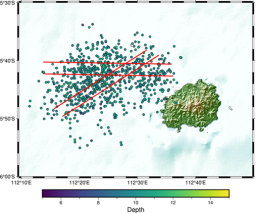
Gempa bumi yang terjadi pada tanggal 22 Maret 2024 di sekitar Pulau Bawean memicu serangkaian gempa susulan. Penelitian ini bertujuan untuk relokasi gempa susulan yang terjadi di sekitar Pulau Bawean dengan menggunakan metode Double Difference untuk meningkatkan akurasi penentuan hiposenter. Data yang digunakan dalam penelitian ini adalah katalog gempa bumi dari Stasiun Geofisika Malang, dengan total 878 kejadian yang dianalisis selama periode 22 Maret 2024 hingga 12 Juni 2024. Hasil relokasi menunjukkan adanya pergeseran lokasi hiposenter yang cenderung berkelompok di area barat laut Pulau Bawean. Secara visual, hiposenter yang direlokasi membentuk dua klaster yang jelas dengan orientasi barat-timur dan timur laut-barat daya. Nilai residual dari hiposenter yang direlokasi menunjukkan penurunan yang signifikan, mendekati nol. Perubahan signifikan diamati pada gempa bumi yang awalnya tercatat pada kedalaman 10 km, yang setelah relokasi menunjukkan variasi kedalaman yang berbeda-beda. Temuan ini menegaskan efektivitas metode Double Difference dalam memberikan penilaian bahaya seismik yang lebih akurat untuk wilayah tersebut.
References
Aoki, S., Nishi, M., Nakamura, K., Hashimoto, T., Yoshikawa, S., & Ito, H. (2005). Multi-planar structures in the aftershock distribution of the mid niigata prefecture earthquake in 2004. Earth, Planets and Space, 57(5), 411-416. https://doi.org/10.1186/bf03351826
Bai, L., Liu, H., Ritsema, J., Mori, J., Zhang, T., Ishikawa, Y., ... & Li, G. (2016). Faulting structure above the main himalayan thrust as shown by relocated aftershocks of the 2015 mw7.8 gorkha, nepal, earthquake. Geophysical Research Letters, 43(2), 637-642. https://doi.org/10.1002/2015gl066473
Békési, E., Süle, B., Lenkey, L., Lenkey-Bőgér, Á., & Bondár, I. (2017). Double-difference relocation of the 29 january 2011 ml 4.5 oroszlány earthquake and its aftershocks and its relevance to the rheology of the lithosphere and geothermal prospectivity. Acta Geodaetica Et Geophysica, 52(2), 229-242. https://doi.org/10.1007/s40328-017-0195-7
Bulut, F., Bohnhoff, M., Aktar, M., & Dresen, G. (2007).Characterization of aftershock‐fault plane orientations of the 1999 i̇zmit (turkey) earthquake using high‐resolution aftershock locations. Geophysical Research Letters, 34(20). https://doi.org/10.1029/2007gl031154
Daniarsyad, G., Priyobudi, P., Cahyaningrum, A. P., Wibisono, D. G., Sriyanto, S. P. D., Rosid, A., Pranata, B., Gunawan, I., Fatchurochman, I., & Daryono, D. (2023). Analysis on the Causative Fault of the 2021 Mw 6.0 Tehoru Earthquake in the South Coast of Seram Island: A Preliminary Result. E3S Web of Conferences, 447. https://doi.org/10.1051/e3sconf/202344701020
Enescu, B., Mori, J., & Ohmi, S. (2005). Double-difference relocations of the 2004 off the kii peninsula earthquakes. Earth, Planets and Space, 57(4), 357-362. https://doi.org/10.1186/bf03352576
Feng, L., Xu, W., Ruan, X., Zhao, M., & Yi, G. (2015). A more accurate relocation of the 2013 m s7.0 lushan, sichuan, china, earthquake sequence, and the seismogenic structure analysis. Journal of Seismology, 19(3), 653-665. https://doi.org/10.1007/s10950-015-9485-0
Got, J.L., J. Fréchet & F.W. Klein. (1994). Deep fault plane geometry inferred from multiplet relative relocation beneath the south flank of Kilauea, J. Geophys. R. 99, 15375-15386.
Hutchings, S. J. and Mooney, W. D. (2021). The seismicity of indonesia and tectonic implications. Geochemistry, Geophysics, Geosystems, 22(9). https://doi.org/10.1029/2021gc009812
Irsyam, M., Cummins, P. R., Asrurifak, M., Faizal, L., Natawidjaja, D. H., Widiyantoro, S., Meilano, I., Triyoso, W., Rudiyanto, A., Hidayati, S., Ridwan, M., Hanifa, N. R., & Syahbana, A. J. (2020). Development of the 2017 national seismic hazard maps of Indonesia. Earthquake Spectra, 36(1_suppl). https://doi.org/10.1177/8755293020951206
Isken, M. and Mooney, W. D. (2017). Relocated hypocenters and structural analysis from waveform modeling of aftershocks from the 2011 prague, oklahoma, earthquake sequence. Bulletin of the Seismological Society of America, 107(2), 553-562. https://doi.org/10.1785/0120160150
Katsumata, K., Ichiyanagi, M., Ohzono, M., Aoyama, H., Tanaka, R., Takada, M., ... & Ueno, T. (2019). The 2018 hokkaido eastern iburi earthquake (mjma = 6.7) was triggered by a strike-slip faulting in a stepover segment: insights from the aftershock distribution and the focal mechanism solution of the main shock. Earth, Planets and Space, 71(1). https://doi.org/10.1186/s40623-019-1032-8
Kompas.com. (2024). BMKG ungkap 12 fakta gempa Bawean berpusat di sesar tua pola Meratus. https://www.kompas.com/tren/read/2024/03/25/073000265/bmkg-ungkap-12-fakta-gempa-bawean-berpusat-di-sesar-tua-pola-meratus#google_vignette.
Lanza, F., Chamberlain, C. J., Jacobs, K., Warren‐Smith, E., Godfrey, H., Kortink, M., ... & Eberhart‐Phillips, D. (2019). Crustal fault connectivity of the mw 7.8 2016 kaikōura earthquake constrained by aftershock relocations. Geophysical Research Letters, 46(12), 6487-6496. https://doi.org/10.1029/2019gl082780
Lunt, P. (2019). The origin of the East Java Sea basins deduced from sequence stratigraphy, Marine and Petroleum Geology, 105, 17 –31.
Muntafi, Y. (2021). Seismic properties and fractal dimension of subduction zone in java and its vicinity using data from 1906 to 2020. International Journal of GEOMATE, 21(85). https://doi.org/10.21660/2021.85.j2217
Novianto, A., S., S., Prasetyadi, C., & Setiawan, T. (2020). Structural Model of Kendeng Basin: A New Concept of Oil and Gas Exploration. Open Journal of Yangtze Oil and Gas, 05(04). https://doi.org/10.4236/ojogas.2020.54016
Primananda, D. L. A. and Muhajir, M. (2023). Modelling earthquake disaster damage due depth of epicenter and magnitude using spatial regression. BAREKENG: Jurnal Ilmu Matematika Dan Terapan, 17(3), 1221-1234. https://doi.org/10.30598/barekengvol17iss3pp1221-1234
Purba, J., Harisma, H., Priadi, R., Amelia, R., Dwilyantari, A. A. I., Jaya, L. M. G., Restele, L. O., & Putra, I. M. W. G. (2024). Surface deformation and its implications for land degradation after the 2021 Flores earthquake (M7.4) using differential interferometry synthetic aperture radar. Journal of Degraded and Mining Lands Management, 12(1), 6819–6831. https://doi.org/10.15243/jdmlm.2024.121.6819
Purba, J., Restele, L. O., Hadini, L. O., Usman, I., Hasria, H., & Harisma, H. (2024). SPATIAL STUDY OF SEISMIC HAZARD USING CLASSICAL PROBABILISTIC SEISMIC HAZARD ANALYSIS (PSHA) METHOD IN THE KENDARI CITY AREA. Indonesian Physical Review, 7(3), 300–318. https://doi.org/10.29303/ipr.v7i3.325
Ramdhan, M., Priyobudi, Mursitantyo, A., Palgunadi, K. H., Panjaitan, A. L., & Jatnika, J. (2023). Hypocenter relocation of the mw 5.9 eastern manggarai earthquake 2022 and its aftershocks based on bmkg seismic network. IOP Conference Series: Earth and Environmental Science, 1227(1), 012042. https://doi.org/10.1088/1755-1315/1227/1/012042
Rosana, N. and Prasita, V. D. (2018). Potential of fishing port development in the east java. IOP Conference Series: Earth and Environmental Science, 135, 012020. https://doi.org/10.1088/1755-1315/135/1/012020
Santosa, B.J. (2008). Seismogram Analysis of the Earthquakes in Sumatra on WRAB Observation Station: S Wave Velocity Structure on Subduction Zone of Sumatra-Java, ITB J. Sci., 40 (1), 71 – 87
Sunardi, B., Rohadi, S., Masturyono, Widiyantoro, S., Sulastri, Susilanto, P., Hardy, T., & Setyonegoro W. (2012). Relokasi Hiposenter Gempabumi Wilayah Jawa Menggunakan Teknik Double Difference, Jurnal Meteorologi dan Geofisika, 13 (3), 179 – 188
Supendi, P., Nugraha, A. D., & Wıjaya, T. (2017). Relocation and focal mechanism of aftershocks pidie jaya earthquake (mw6.5) dec 7th, 2016 using bmkg network. Jurnal Geofisika, 15(3), 17. https://doi.org/10.36435/jgf.v15i1.19
Urata, Y., Yoshida, K., Fukuyama, E., & Kubo, H. (2017). 3-d dynamic rupture simulations of the 2016 kumamoto, japan, earthquake. Earth, Planets and Space, 69(1).https://doi.org/10.1186/s40623-017-0733-0
Waldhauser, F. (2001). HypoDD: A Computer Program to compute Double Difference Earthquake location. U. S. Geol. Surv. Openfilereport, 01-113, Menlo Park, California.
Waldhauser, F. and Schaff, D. P. (2007). Regional and teleseismic double‐difference earthquake relocation using waveform cross‐correlation and global bulletin data. Journal of Geophysical Research: Solid Earth, 112(B12). https://doi.org/10.1029/2007jb004938
Woessner, J., Schorlemmer, D., Wiemer, S., & M, P. R. (2006). Spatial correlation of aftershock locations and on‐fault main shock properties. Journal of Geophysical Research: Solid Earth, 111(B8). https://doi.org/10.1029/2005jb003961
Yamanaka, H., Hiramatsu, Y., & Katao, H. (2014). Spatial distribution of atypical aftershocks of the 1995 hyogo-ken nanbu earthquake. Earth, Planets and Space, 54(10), 933-945. https://doi.org/10.1186/bf03352441
Zhu, S. and Miao, M. (2015). How did the 2013 lushan earthquake (ms = 7.0) trigger its aftershocks? insights from static coulomb stress change calculations. Pure and Applied Geophysics, 172(10), 2481-2494. https://doi.org/10.1007/s00024-015-1064-3
Downloads
Published
How to Cite
Issue
Section
License
Copyright (c) 2025 Jurnal Rekayasa Geofisika Indonesia

This work is licensed under a Creative Commons Attribution 4.0 International License.