Computational Performance Analysis of Full Vectorization and Nested Loop in Last–Kubik Gravity Forward Modeling
DOI:
https://doi.org/10.56099/jrgi.v8i01.194Keywords:
Computational Perfomance, Full Vectorization, Nested Loop, Gravity Forward Modeling, Last–Kubik KernelAbstract
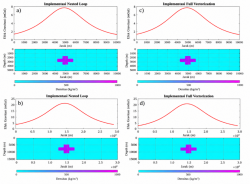
Gravity forward modeling based on the Last–Kubik kernel requires intensive computation as the number of model blocks and observation points increases. This study analyzes the computational performance of Full Vectorization (FV) compared with Nested Loop (NL) without modifying the mathematical formulation of the Last–Kubik kernel. Experiments were conducted using synthetic models with 20 configurations ranging from 20,000 to 168,200 blocks. Algorithm performance was evaluated based on gravity-response consistency, computational time, and memory usage. Computational time was assessed using Total Execution Time (TET) and Mean Core Computational Time (MCCT) from 30 repetitions, while memory usage was evaluated using Kernel Workspace Memory Increase (KWMI). The results show that the FV and NL implementations produce numerically identical gravity responses, with a maximum absolute difference of 0 for the tested configurations. FV provides an MCCT speedup of approximately 6–7 times for small to medium-sized models, but the speedup decreases to 1.56 times at 168,200 blocks. In contrast, FV requires approximately 18 times more memory than NL. Regression analysis shows a very strong linear relationship between KWMI and the number of observation–block pairs. The results demonstrate that FV effectively accelerates gravity forward modeling but has scalability limitations due to its substantially higher memory requirements
References
Grandis, H. (2009). Pengantar Pemodelan Inversi Geofisika. Jakarta: Himpunan Ahli Geofisika Indonesia (HAGI), pp. 45–104.
Hamimu, L. (2023). ForLoveDCs: A set of MATLAB function for calculating the forward modeling of multimode Love wave dispersion curves. Journal of Software Engineering and Simulation, 9, 129–140.
Hamimu, L., Safani, J., & Ngkoimani, L. O. (2015). Developed forward and inverse modelling of Vertical Electrical Sounding (VES) using MATLAB codes implementation. International Journal of Science and Research, 4(11), 1592–1597. https://doi.org/10.21275/v4i11.NOV151521
Hamimu, L., Cahyono, E., Budiman, H., Haraty, S. R., & Ransi, N. (2024a). Numerical analysis of the geophysical parameter sensitivity on the multimode Love wave dispersion curves. Journal of Physics Communications, 8, 015007. https://doi.org/10.1088/2399-6528/ad1f71
Hamimu, L., Haraty, S. R., Rubaiyn, A., Juarzan, L. O. I., & Indrawati. (2024b). Computation and modelling of seismic refraction tomography for anisotropic medium based on pseudo bending method. Journal of Physics: Conference Series, 2734(1), 012049. https://doi.org/10.1088/1742-6596/2734/1/012049
Hamimu, L., Aba, L., Muliddin, Cahyono, E., Juarzan, L. O. I., & Indrawati. (2025). Implementing a new inversion technique of geophysical data incorporating global optimization method based on systematic search, permutation, and sensitivity. IOP Conference Series: Earth and Environmental Science, 1521(1), 012017. https://doi.org/10.1088/1755-1315/1521/1/012017
Last, B. J., & Kubik, K. (1983). Compact gravity inversion. Geophysics, 48(6), 713–721. https://doi.org/10.1190/1.1441501
Moskovka, A., Rahman, T., Valdman, J., & Vatne, J. E. (2026). Frameworking the vectorized basic linear algebra for prototyping codes in MATLAB. Applied Mathematics and Computation, 513, 129778. https://doi.org/10.1016/j.amc.2025.129778
Tchuigwa, B. S. S., Krmela, J., Pokorny, J., Krmelová, V., & Jilek, P. (2024). VectFEM: A generalized MATLAB-based vectorized algorithm for the computation of global matrix/force for finite elements of any type and approximation order in linear elasticity. Zeitschrift für Angewandte Mathematik und Physik, 75, 150. https://doi.org/10.1007/s00033-024-02293-w
Wang, W., Zheng, J., Ren, B., Yin, Z., Wan, W., Wang, Y., Gan, L., Zhang, Z., Zhang, W., Fu, H., & Chen, X. (2026). Accelerating three-dimensional seismic wave simulations on ARM using a hybrid half-precision and scalable vector extension approach. Geophysical Journal International, Volume 244, Page 1–12. https://doi.org/10.1093/gji/ggaf496
Downloads
Published
How to Cite
Issue
Section
License
Copyright (c) 2026 Jurnal Rekayasa Geofisika Indonesia

This work is licensed under a Creative Commons Attribution 4.0 International License.